Anew No Poetry For U: The Real Outside

Much of the original format of this small, dessicated sack of Internet consisted of a stringing of interesting articles, poems, images, and flicks that I encountered or wanted to store in hard memory--what I really want to do is write a more formal organum based on my former material, mainly a collection of odds (with no ends) in the world of outsider art, literature, and experience with some of my commentary. That is, my main interest encompasses people who are creating interesting material even though they are outside the margins of art or society. These include: ()the mentally ill, the ()cognitively different, ()convicts and prisoners, ()folk or naive artist, and to a smaller degree the ()politically shunned (feminists, eco-activists, etc): including artists who were inspired by the works and ideas of outsiders (de-focusing painting, since it is so widespread).

I will slowly and methodically extinct the former material which does not mesh once this white corner of Internet mulch is replaced by a more harmonic repertoire of nick-knacks, a collection of jars.

Consider this "Under Construction" noisy, obstructive, and soon to be polished.

The best way to navigate through this material is to select a topic or tag and view the elements contained within. You can also relax and simply click on the "next" button at the end of the featured post.

!
Showing posts with label Outsider Art. Show all posts

Monday, October 18, 2010

Ghosty Men

The Paper Chase

By FRANZ LIDZ
Published: October 26, 2003
New York Times


Correction Appended

MY father never had much use for fairy tales. The fifth of five brothers raised in a one-bedroom tenement on the Lower East Side, he preferred real-life grotesqueries. And so at bedtime, I would listen raptly to his urban horror stories, tales that filled the dark with chimera, bogeymen, golems.

The most macabre was the tale of the Collyer Brothers, the hermit hoarders of Harlem. In lugubrious tones not unlike Boris Karloff's, my father described the vague aura of evil that had endowed the four-story brownstone on the northwest corner of Fifth Avenue and 128th Street for much of the 1930's and 40's. It was there, barricaded in a sanctuary of junk, that the blind and bedridden Homer Collyer lived with his devoted younger brother, Langley, the elderly scions of an upper-class Manhattan family.

And it was there that they amassed one of the world's legendary collections of urban junk, a collection so extraordinary that their accomplishment, such as it was, came to represent the ultimate New York cautionary tale.

The Collyer brothers' saga confirms a New Yorker's worst nightmare: crumpled people living in crumpled rooms with their crumpled possessions, the crowded chaos of the city refracted in their homes. It's not that Gothamites hoard more than other people; it's that they have less room to hoard in.

Even now, after more than a half century, the Collyer name still resonates. New York City firefighters refer to an emergency call to a junk-jammed apartment as a ''Collyer.'' The brothers are recalled whenever a recluse dies amid an accumulation of junk; as a middle-aged woman snapped at her parents in a Roz Chast cartoon in a recent issue of The New Yorker: ''You guys never throw anything out! You're starting to live like the COLLYER BROTHERS.''

The elderly Collyers were well-to-do sons of a prominent Manhattan gynecologist and an opera singer. Homer had been Phi Beta Kappa at Columbia, where he earned his degree in admiralty law. Langley was a pianist who had performed at Carnegie Hall.

The brothers had moved to Harlem in 1909 when they were in their 20's and the neighborhood was a fashionable, and white, suburb of Manhattan. They became more and more reclusive as the neighborhood went shabby on them, booby-trapping their home with midnight street pickings and turning it into a sealed fortress of ephemera, 180 tons of it by the end. Children chucked rocks at their windows and called them ''ghosty men.''

My father recounted in great detail the rotting decadence of what had been a Victorian showplace. The Collyers had carved a network out of the neck-deep rubble. Within the winding warrens were tattered toys and chipped chandeliers, broken baby carriages and smashed baby grands, crushed violins and cracked mantel clocks, moldering hope chests crammed with monogrammed linen.

Homer went blind in the mid-30's and was crippled by rheumatism in 1940. His brother nursed him, washed him, fed him a hundred oranges a week in a bizarre attempt to cure his blindness and saved newspapers for him to read when he regained his sight. Hundreds of thousands of newspapers.

Langley was buried in an avalanche of rubbish in 1947 when he tripped one of his elaborate booby traps while bringing Homer dinner. Thanks to my father, I knew all the particulars: how Homer had starved to death, how Langley's body had been gnawed by rats, how the police had searched the city for Langley for nearly three weeks while he lay entombed in the debris of his own house. To my 7-year-old ears, the cruel twist was deliciously gruesome: Homer and Langley had been killed by the very bulwarks they had raised to keep the world out of their lives.

The shadowy world of Homer and Langley was resurrected this month in an exhibition at the Inquiring Mind Gallery in Saugerties, N.Y. In this show, Richard Finkelstein, a Manhattan painter, has reimagined the brothers' lives in 17 black and white drawings called ''Love and Squalor on 128th Street.'' One sketch depicts the brothers dancing in the debris before an audience of female mannequins, the women in their lives.

A murder mystery by Mark Saltzman called ''Clutter: The True Story of the Collyer Brothers Who Never Threw Anything Out,'' opens next February in Burbank, Calif. And last year the Collyers popped up at the Gramercy Arts Theater on East 23rd Street in ''The Dazzle,'' a period drama by Richard Greenberg that was loosely based on the brothers' story.

Very loosely. Like nearly everyone else who invokes the Collyers, the playwright acknowledged he knew next to nothing about them. Mr. Greenberg was less interested in historical accuracy than the ''idea'' of the Collyers; to him, they were just ''two people propelled by the romantic possibilities of life, although perhaps not as we might conventionally define them.''

''Some see eccentrics as 'the other,' and in terms of pure irrationality,'' Mr. Greenberg added in a interview published around the time the play was produced. ''But I see such eccentrics as having a very pure logic, although their needs are different from most of ours.''

Plenty of Nothing

New York has long teemed with pack rats who can't pass a garbage bin without lifting the lid. A few became legends.

In the 1940's, a woman named Theresa Fox was found dead in the kitchen of her three-room hovel -- somewhere in Queens, according to one newspaper account -- with $1,300 stashed in the ratty stockings she wore. Ms. Fox, who was said to have owned property in Brooklyn valued at $100,000, had 100 one-pound bags of coffee in her cupboard, and 500 cans of evaporated milk stuffed in her mattress. The drawers of her bedroom bureau brimmed with sugar, and dozens of loaves of bread were stacked against the walls in a fieldstone pattern.

During the 50's, a shabby, plucked sparrow of a man named Charles Huffman was found dead in a Brooklyn street with no money in his pockets; the police said his $7-a-week room was piled with bank books and more than $500,000 in stock certificates.

And in the 60's a realtor named George Aichele, who lived at 61 East 86th Street in Yorkville, was found dead in a dim catacomb of trash and cash. Amid the stacks of old newspapers, heaps of used razor blades, drifts of pipes and birdcages and zithers was a paper bag containing a single penny and a note explaining that it had been found in front of the house in December 1957.

''New Yorkers live in such tight spaces that hoarding gets out of control faster,'' said Kate Sherman, director of special projects at the New York Service Program for Older People on West 91st Street. She says if New Yorkers moved more, they might edit their junk more. ''But with rent control,'' she conceded, ''people tend to stay in the same place.''

Last year Ms. Sherman gave a lecture at the center where she works titled ''I've Got Plenty of Nothing: the Dynamics of Hoarding,'' in which she cast the malady as materialism run amok.

''Part of it is about living in this age and society where there are so many papers to keep track of,'' she said. ''It is really hard to know what to throw away. And if you are having memory problems or do not have the energy to take bales of paper to the recycling area, it can easily get out of hand. But I think with extreme hoarders, there's a level of it that's kind of beyond rational explanation.''

Social scientists disagree as to exactly what causes obsessive hoarding. In its December 1960 issue, the Journal of Chronic Diseases branded recluses like the Collyers ''deviants who are often surrounded by mystery and violence.''

It is a description that doesn't sit well with Randy Frost, a professor of clinical psychology at Smith College and a consultant to the New York City Hoarding Task Force, a group formed this year by the Weill Medical College of Cornell University to examine hoarding among the elderly.

''If, by deviancy, the researchers meant sinister, that's not true,'' Professor Frost said. ''If anything, hoarders tend to be avoidant and afraid.''

And violent? ''Only in situations where a hoarder's possessions are being taken away,'' he said. ''What is true is that hoarders usually wind up isolated.'' He cited a Boston study of hoarders aged 65 and older. ''Fifty-five percent of them had never been married,'' he said, noting that the figure for the general population is 5 percent.

Secrets of the Pharaohs

Historical accounts of hoarding date back 5,400 years ago to the necropolises of ancient Egyptians. In those vast cities of the dead, rulers of the Memphite dynasties were buried in mastabas, oblong tombs with sloping sides and flat roofs.

Huge storerooms above and below the late pharaoh were jam-packed with his possessions, a collection that typically included furniture, clothing, magical amulets, tools, weapons, game boards, jewelry, jugs of wine and lunch boxes laden with mummified ducks and geese.

''I wouldn't call it junk, exactly,'' said Peter Piccione, a Brooklyn-born Egyptologist who teaches at the College of Charleston in South Carolina.

What would he call it?

''Stuff,'' Professor Piccione replied. ''The ancient Egyptians believed a pharaoh couldn't lead much of a life in the afterlife without his stuff. Basically, they thought you could take it with you.''

All the Collyer brothers took with them were secrets. Though Homer's death and the search for Langley were front-page staples in New York City's 12 daily newspapers, not even the most tenacious reporter could explain why these sons of privilege had been subsumed by their stuff.

'My Junk Is Like a Friend'

The brothers have haunted me ever since my father told me his cautionary tales, and presumably they also haunted the two congenital collectors who helped me tell the brothers' story.

One was Carl Schoettler, a feature writer for The Baltimore Sun and lifelong bibliophile whose apartment is a dark forest of thousands upon thousands upon thousands of books. Together we visited the infamous corner at 128th Street and Fifth Avenue, now a vest-pocket park that is home to a dozen sycamores. We made a pilgrimage to Cypress Hills Cemetery in Brooklyn, where Homer and Langley are buried along with Mae West and Paderewski, the pianist whose notices drove Langley from the concert stage. We talked to old Harlem residents who claimed to have actually met the elusive Collyers.

My other collaborator was my Uncle Arthur, 88, so habitual a hoarder that my mother used to call him the lost Collyer brother. Small, bent and eternally boyish, Uncle Arthur dresses in layers of Salvation Army overcoats kept closed with rusty safety pins. Like a Beckett tramp, he holds his pants up with bits of rope.

Uncle Arthur was a 19-year-old novice collector when he moved to a tiny tenement apartment in Harlem, only three blocks from the Collyer homestead. He already knew that Homer and Langley were the preeminent junk collectors.

''I'd walk by their house and wonder what of value did they have,'' he said. ''You got to have brains to collect that much stuff.

''I always wanted to get in touch with them,'' he added. ''I always wanted to get in touch with anybody who collected as much as I did. They collected more. They had their junk up to the windows. I didn't have that much.''

Uncle Arthur does, however, have quite lot, and he has turned squalor into an art form. Until his collection was ''deaccessioned'' three years ago, nearly every cubic inch of his one-bedroom apartment in Flatbush, Brooklyn, was full, and virtually every surface was covered with heaps of stuff that mounted toward the ceiling. Uncle Arthur hates a vacuum.

Tangled mounds of twine and electrical cord climbed up gentle rolling hills of newspapers still in their plastic sleeves. A riot of shirts and jackets slopped out of stained grocery bags and onto the grubby carpet. The stove and the kitchen counters disappeared from view, lost under a couple of feet of cans, bottles and Calder-like mobiles that Uncle Arthur had fashioned out of clothespins and coat hangers. The bedroom closet was packed with newspapers from the Carter administration; the refrigerator, with English muffins from the end of the Reformation.

He shares the apartment with Wagging II, his cat. ''Collecting junk is my hobby,'' he said. ''My junk is like a friend, another person, another cat.''

An urban prospector, Uncle Arthur trails through the streets of Brooklyn, collecting the detritus of the New York night. He finds his booty in back alleys, subways cars, train stations.

''Believe it or not, I've never bought a single piece of junk,'' Uncle Arthur said. ''I found it all on the street. You'd be surprised what you find once you look. Pennies, nickels, dimes, safety pins, jacks, dice, mirrors, small bottles, dresser handles, screws, wire, cord, moth balls, cigarette packs, pens that say different things on them, bullets.''

He envied the space the Collyer brothers had in their 12-room house. Although by the time he got to Brooklyn in 1975, he was doing pretty well, he never quite got over the feeling that he never met the Collyers' high standards of junk connoisseurship. ''I save this, I save that,'' he said. ''I mix it all together, the good and the bad. So it's my fault.''

He particularly prizes first-edition magazines, bus transfers and parking tickets plucked from windshields. ''People just leave parking tickets on their cars,'' he said wonderingly. ''I must have found thousands of dollars' worth. Every day I could pick one up.''

My father used to claim that Uncle Arthur's hoarding was his way of ''channeling aggression and sublimating it.'' And there is perhaps a defensiveness behind Uncle Arthur's hobby. Like Langley Collyer, he builds barricades, and sets booby traps and nests inside his walls of junk. But he is incapable of aggression. The only time I've ever seen Uncle Arthur really get mad was when my father told him to give it up. The tiny folds that line his pale forehead are not engraved by anger but merely the result of squinting down at the sidewalk.

Uncle Arthur has his own theory as to what lies behind his hoarding. ''Maybe it's something I missed in my childhood,'' he said. ''Like something big. The thing is you don't have to pay for junk. It's free.''

He's not insensitive. He knows that people sniff at his junk, and frequently. ''My landlord doesn't like my hobby,'' he conceded. ''But what can he do? I've got a lease.''


****************************************

Photos: The day in March 1947 when the Collyers' mansion on Fifth Avenue and 128th Street was raided, above; the removal of a Steinway piano, above left; relatives examining the ruins, above right; the search for Langley's body, below, and, bottom, Arthur Lidz, a slightly less compulsive pack rat, with his nephew Franz. (Photos by Top left, top right and below, Corbis/Bettmann; above, The New York Times; bottom, Chester Higgins Jr./The New York Times)(pg. 9); Langley Collyer, below, and the mess in which he and his brother, Homer, lived for decades. Their saga confirms a New Yorker's worst nightmare. (Photos by Top left and top right, Corbis/Bettmann; above, The New York Times)(pg. 1)


Franz Lidz is the author of ''Ghosty Men: The Strange but True Story of the Collyer Brothers, New York's Greatest Hoarders,'' being published this month by Bloomsbury.

***************************************************
Correction: November 2, 2003, Sunday A front-page article in this section last Sunday about the reclusive Collyer brothers referred incorrectly to another grave in Cypress Hills Cemetery, where the Collyers are buried. The pianist Ignace Jan Paderewski, who died in 1941, is not buried there now; his heart was placed in a crypt there in 1945 but moved in 1986 to the Shrine of Our Lady of Czestochowa in Doylestown, Pa. A plaque in Cypress Hills still marks the site.

Sunday, October 17, 2010

On Schizophrenic Poetry

To cite this Article: Bakare, Muideen Owolabi 'Morbid and Insight Poetry: A Glimpse at Schizophrenia through the Window of Poetry', Journal of Creativity in Mental Health, 4:3, 217 - 224

Abstract

Creativity, language, and psychotic disorders may share a common neurological and evolutionary background. These processes are uniquely human and may converge in poetic expression that illuminates the inner world of patients suffering from schizophrenia. Two types of poetry that may be written by patients with schizophrenia are identified as morbid and insight poetry. Clinicians are urged to pay attention to the writings of their patients and encourage them to document the experiences of their illness. Writing may help patients gain an in-depth insight into their own inner world and the nature of their illness. Poetry may also help clinicians understand the peculiar individual psychodynamics of their patients' illness.
Keywords: morbid; insight; poetry; language; psychosis; schizophrenia; creativity

Introduction

Individuals with mental health disorders may experience heightened creativity during the course of their illness (Andreasen, 1987; Buck & Kramer, 1977; Claman, 2001; Rihmer, Gonda, & Rihmer, 2006). Patients with schizophrenia, for example, may find an expressive outlet through writing poetry (Buck & Kramer; Miliavskii, 1981; von Keyserlingk, 1978; Zapotoczky, 2005). As individuals with schizophrenia cope with various phases of their condition, the quality of their behaviors and interactions may vary considerably. As such, a particular interest was sparked in exploring the poetic expression of individuals with schizophrenia during periods of remission and active phases of their disorder. From interactions with patients with schizophrenia as they constructed their poetry, and reviews of their work, two broad categories of poetry were identified. Morbid poetry is poetry written while the individual with schizophrenia is experiencing the worst of the disease. Conversely, insight poetry is our term for schizophrenic poetic expression while individuals are lucid and in remission. It is suggested that practitioners can assess the mental well-being of individuals with schizophrenia by analyzing the language and quality of their poems. This can be helpful for clinicians to understand the mental processes of their clients with schizophrenia.

SCHIZOPHRENIA AND ITS ETIOLOGY CONTROVERSY

  Gelder, Gath, Mayou, and Cowen (1996) suggest that schizophrenia is a complex disorder and may be the result of a constellation of brain dysfunctions instead of a single diagnosis as presently classified in modern classifications such as the International Statistical Classification of Diseases and Related Health Problems (ICD-10; World Health Organization [WHO], 2007) and the Diagnostic and Statistical Manual of Mental Disorders (DSM-IV-TR; American Psychiatric Association [APA], 2000). However, a recent argument suggesting schizophrenia and other psychotic disorders might originate from a single gene located in a specific region of the brain associated with language development is worth attention (Berlim, Mattevi, Belmonte-de-Abreu, & Crow, 2003; Crow, 1997, 2000). For this recent argument to be fully applicable, presumption of a theory of unitary psychosis with severity continuum needs to be made.

LANGUAGE, POETRY, AND PSYCHOSIS

  Poetry allows access to the inner life, thought process, and emotions of the writer. Poetry can serve as an outlet for emotional expression and description of experience, or it can expand into surrealism. Surrealistic poetry may read like the thought processes and experiences of those suffering from schizophrenia (Al'tima, 1995; Graves & Schermer, 1998; Lombardo, 2007; Powell, 1998; Rhodes, Dowker, & Claridge, 1995; Zapotoczky, 2005). Therefore, it is not surprising that poem writing has been noted as a common phenomenon in patients with schizophrenia and other psychotic disorders (Buck & Kramer, 1997; Miliavskii, 1981; von Keyserlingk, 1978; Zapotoczky). The assertion that schizophrenia and language development may be tied together genetically (Crow, 2008) may explain why schizophrenia perpetuates despite its reproductive disadvantage. Crow's work on the genetics of language and psychosis may also explain the associations between schizophrenia, other psychotic disorders, and poetry as a function of brain development and heredity.

MORBID POETRY AND SCHIZOPHRENIA

  Part of the criteria for making diagnosis of schizophrenia is the presence of functional thought disorders (Gelder et al., 1996), which can be revealed in verbal and written expressions. Poems of individuals with schizophrenia during their defective cognitive states can offer a great insight into their thought processes and emotions. Specifically, poetry writing during a morbid state could reveal a peculiar play with words, loosening of associations, derailment of thought, and formation of new words (i.e., neologisms). Holistically, morbid poetry may also offer insight into the delusional themes expressed by patients in their writing. Clinically, Miliavskii (1981) suggested that verses of patients written in the active phase of their schizophrenia could serve as a differential diagnostic tool, helping clinicians assess the severity of the disorder.

Case Illustration of Morbid Poetry

  R is a 44-year-old male with a diagnosis of schizophrenia who was in treatment at Federal Neuro-psychiatric Hospital, New Haven, Enugu, Enugu State, Nigeria. R wrote several poems, and two of his poems that seemed to be the best examples of his variable cognitive states were analyzed. The first was written when he was acutely ill and mentally unstable. The second was written when he began his recovery from the acute episode of his psychotic illness. Reproduced below is the first poem, titled, “Accord is Dead,” written in his acute morbid state:
Vanity fair
Of mythology and superstition
Of the moon and stars
Land and sea, sun and sea
Hollandis
Victory boogie woogie by mondriaan
Van Gogh, the sky over Holland
Waterloo plein temple of Budda
China world focus
Of the cross, the soul and of the heart
The loop baan mode, Greek specialiteiten
Paradiso, Hotel Old Dutch
P& T, PTT, No limit records
Oya! Ali baba of turkey? Ali baba of Lebanon?
Camel lights, tiger by the tail
It is Ali again in Venice
Vlisso textites
Familiar variety, caballero
Vlissingen, time will tell
Drummer! Kofi the drummer boy
Drumboy in Africa
Pakistan Linking - Hugo Boss woman
Air freshener misdefined by commission
Hugo Boss Number one of Chavez by Fidel
Acapulco, Mexico after dark
Jonas had a Gucci
London-Paris-Newyork, Cuba-Mexico-Brazil
OBJ with the queen
Some one called the white house
Metropole by night, kingsize
Antwerp, united we stand
How many licks?
Ecstacy the summary
Using the poem as a clinical tool, I found it lacked a key point other than the attempt at citing different regions of the world. Also, there was a peculiar play on words, which was curious and seemed to suggest some comprehensibleness to this poem. There was an obvious loosening of associations and formation of new words. The observation in this poem is consistent with the recommendations of Miliavskii (1981) to use poetry as a diagnostic tool. There were also markers in this poem consistent with some of the diagnostic criteria needed to make a diagnosis of schizophrenia (APA, 2000; WHO, 2007).
The second poem, titled “Accord Concordiel,” was written by the same patient during a more stable mental state:
Above the drumbeats of china
Above the decayed ruins of Egypt
To the world we left behind
Adam and Eve
To a new world order
The C.I.S
To structure and adjust the new era
Robert Mugabe and the white farmers of Zimbabwe
Definite and absolute
The state of independence must be
The rewards and gains of desirable labor becomes state of affair
Of a common interest and general perspective
The right of individuals becomes the rule of law
For all we are and have
Rules of expectation and achievement become unchanged
A close examination of this work in relation to the first poem revealed a lesser degree of play on words, neologisms, and loosening of associations. There appeared to be a definitive goal to which the patient was alluding, possibly a unified world and an egalitarian society. This particular poem seemed to have more meaning when compared to the first poem. Despite this poetry showing some stable thought patterns, I still considered this poem as morbid. Morbid poetry may be assessed along a continuum, with some poems expressing severe surrealistic qualities, while others may display a mix of rational thought and defective thought process. Other researchers have explored how poetry may be a clinical lens for understanding a patient with schizophrenia (Maia & Jorge, 2001).

Clinical Significance of Morbid Poetry

  One clinical advantage of assessing morbid poetry at different stages of a psychotic illness is that it can help assess psychopathology and mental state of the patient. Analysis of the written text may help confirm a diagnosis. It can also help assess a patient's response to treatment by illustrating the differences in coherence and thinking. This was evidenced in the previous poems written at different intervals of the patient's illness. These written works may help clinicians determine when an individual with schizophrenia is at the brink of a lapse into psychotic thinking.

INSIGHT POETRY AND SCHIZOPHRENIA

  When individuals with schizophrenia experience lucid and coherent cognitive states, they may also express themselves poetically. This particular kind of poetry is often found in patients who have insight into the nature of their illness. Insight poetry often incorporates some features of psychodynamic psychotherapy (Wallach, 2005) and cognitive behavioral therapy (Tolton, 2004) to bring about the process of healing, recovery, and adaptation in the affected patients. Therefore, while insight poetry may also serve as a diagnostic tool, this kind of written expression may have therapeutic advantages as well.

Case Illustration of Insight Poetry

  The healing process of insight poetry written by people who suffer from mental disorders associated with psychotic symptoms is well documented (Hayashi, 1998; Powell, 1998; Tolton, 2004). Tolton shared a first-person account of how insight poetry helped him walk through his illness. Taken from his work are two poems partly reproduced below as illustration:
Psychosis
Your delusive way of thinking
Makes you behave eccentrically
And you just don't know you're poorly
Hypersensitivity (Tolton, p. 472)
The above poem showed some element of cognitive restructuring and behavioral modification. It also showed a change in perception of situation as documented in Tolton's account of “How I saw my illness” and “How I see my illness” (Tolton, 2004). Reproduced in part below is another poem in the first-person account of Tolton.
Psychosis, Disturbed Thoughts, Light and Hope
That thought was delusion
I've nipped it in the bud
I can recognize thought rubbish
And split factual from the dud (p. 472)
The above poem also showed some cognition restructuring. The author wrote about recognizing signs of his illness and revealed his ability to differentiate between reality and delusional fantasy.

Clinical Significance of Insight Poetry

Insight poetry may serve several clinical purposes. First, this kind of writing may help clinicians assess patients' recovery by highlighting self-awareness and cognitive changes. It could also help patients understand their inner world and work as a potential coping mechanism by allowing patients to document their change and relevant struggles. By paying attention to the poetic expression of their patients, clinicians can use this tool to better empathize with and relate to their patients' experiences. As clinicians begin to know the subtle nuances of a patient's expression, they can become attuned to changes in the poetry and respond therapeutically. Previous insight poems may work as reminders for patients about their awareness and may be used as examples of therapeutic goals, especially after a relapse. In this way, each person may experience individualized, patient-centered care.

CONCLUSION

  Poetic expression offers patients and clinicians an outlet to explore and document the full range of emotional and cognitive expressions. As seen on a spectrum of healing and illness, morbid poetry represents a form of communication that illustrates the surrealistic quality of the schizophrenic mind. In light of the tie between language and psychotic disorders, morbid poetry may offer a glimpse into the ebb and flow of chronic psychosis. As individuals progress in treatment, their words may move from disorganization and chaos to self-reflection and healing. When this shift happens, a new form of expression, called insight poetry, emerges. While both insight poetry and morbid poetry can be used as assessment lenses, insight poetry offers patients their personalized story of healing. Schizophrenia and other psychotic disorders result in isolation and distress for affected individuals. Poetry is one outlet to help them express their world and connect with a helping professional. Professionals may find poetry helpful to gaining a deeper understanding of their patients' stories of illness and wellness.

REFERENCES

  • 1. Al'tima, IaA (1995) The neuropsychological hypothesis of the mechanisms of poetic inspiration. Zh Vyssh Nerv Deiat Im I P Pavlova 45 , pp. 227-241.
  • 2. American Psychiatric Association (2000) Diagnostic and statistical manual of mental disorders text rev 4th, Author , Washington, DC
  • 3. Andreasen, N. C. (1987) Creativity and mental illness: Prevalence rates in writers and their first degree relatives. American Journal of Psychiatry 151 , pp. 1650-1656.
  • 4. Berlim, M. T. , Mattevi, B. S. , Belmonte-de-Abreu, P. and Crow, T. J. (2003) The etiology of schizophrenia and the origin of language: Overview of a theory. Comprehensive Psychiatry 44 , pp. 7-14. [ csa ] [ crossref ]
  • 5. Buck, L. A. and Kramer, A. (1977) Creative potential in schizophrenia. Psychiatry 40 , pp. 146-162.
  • 6. Claman, H. N. (2001) Creativity and illness: Christopher Smart and Samuel Johnson. The Pharos 64:3 , pp. 4-7.
  • 7. Crow, T. J. (1997) Is schizophrenia the price that Homo sapiens pays for language. Schizophrenia Research 28 , pp. 127-141. — ? [ crossref ] [ csa ]
  • 8. Crow, T. J. (2000) Schizophrenia as the price that Homo sapiens pays for language: A resolution of the central paradox in the origin of the species. Brain Research Reviews 31 , pp. 118-129. [ crossref ]
  • 9. Crow, T. J. (2008) The 'big bang' theory of the origin of psychosis and the faculty of language. Schizophrenia Research 102 , pp. 31-52. [ crossref ]
  • 10. Gelder, M. , Gath, D. , Mayou, R. and Cowen, P. Gelder, M. , Gath, D. , Mayou, R. and Cowen, P. (eds) (1996) Schizophrenia and schizophrenia-like disorders. Oxford textbook of psychiatry pp. 246-293. 3rd, Oxford University Press , New York
  • 11. Graves, M. and Schermer, V. L. (1998) The wounded male persona and the mysterious feminine in the poetry of James Wright: A study in the transformation of the self. Psychoanalytic Review 85 , pp. 849-869. [ csa ]
  • 12. Hayashi, Y. (1998) The expressive psychopathology of the Japanese poet, Sakutaro Hagiwara. Psychiatry and Clinical Neurosciences 52 , pp. 621-627. [ crossref ] [ csa ]
  • 13. Lombardo, G. T. (2007) An inquiry into the sources of poetic vision: Part I - The path to inspiration. Journal of the American Academy of Psychoanalysis and Dynamic Psychiatry 35 , pp. 351-371.
  • 14. Maia, R. M. and Jorge, M. S. (2001) Understanding the person with schizophrenia from the point of view of Merleau-Ponty. Revista Brasileira de Enfermagem 54 , pp. 558-567.
  • 15. Miliavskii, V. M. (1981) Psychopathology of poetry writing of schizophrenic patients while ill. Zh Nevropatol Psikhiatr Im S S Korsakova 81:1 , pp. 104-108.
  • 16. Powell, C. (1998) The nameless father in the poetry and life of Francis Webb. Australian and New Zealand Journal of Psychiatry 32 , pp. 488-495. [informaworld]
  • 17. Rhodes, N. , Dowker, A. and Claridge, G. (1995) Subject matter and poetic devices in psychotics' poetry. British Journal of Medical Psychology 68:Pt. 4 , pp. 311-321.
  • 18. Rihmer, Z. , Gonda, X. and Rihmer, A. (2006) Creativity and mental illness. Psychiatr Hung 21 , pp. 288-294.
  • 19. Tolton, J. C. (2004) First person account: How insight poetry helped me to overcome my illness. Schizophrenia Bulletin 30 , pp. 469-472. [ csa ]
  • 20. von Keyserlingk, H. (1978) Literary creations of schizophrenics. Psychiatr Neurol Med Psychol (Leipz) 30 , pp. 166-172.
  • 21. Wallach, M. (2005) Listening to Oedipus: Two poems by sons about fathers. Journal of the American Academy of Psychoanalysis and Dynamic Psychiatry 33:1 , pp. 191-206.
  • 22. http://apps.who.int/classifications/apps/icd/icd10online/ — World Health Organization. (2007). International statistical classification of diseases and related health problems (10th rev.)
  • 23. Zapotoczky, H. G. (2005) Poetry and schizophrenia. Fortschr Neurol Psychiatr 73:Suppl 1 , pp. 84-87.

Monday, October 4, 2010

Outsider Insider : Aloise Corbaz (1955)

Aloise Corbaz was diagnosed with schizophrenia and symbolized much of her vibrant thoughts of erotic love and historical romance (her forbidden love for German emperor Wilhem II, for instance) within her tightly packed and colorful drawings. Dubufett, who collected her work, tells us "She cured herself by the process which consists in ceasing to fight the illness and undertaking the contrary to cultivate it, to turn it into an exciting reason for living."


She claims that her female figures wear dark glasses because "They were embarrassed when it comes to kissing, so they wear glasses."

Here are some of her writings from Ubuweb, although they have a highly disappointing collection of outsider work. Outsider poetry is hard enough to find on the Internet and I have devoted much of my time to its collection. If you have any collected poems or writings by outsider artists (known or unknown), please let me know (you shall find a way).

***

[The following are excerpts of texts embedded in a 1941 sketchbook, as transcribed by Jacqueline Porret-Forel. They can be read here as small poems or as markers of the range of interests in the larger works. The visual images presented on ubuweb are, however, from distinctively different pieces.]

The living Lantern of Ouchy Opera

                Ida Deriaz Chief Yersin Lila Goergens

                                                Raise high the torch of Saillens

Manon’s Blue Train

            The General’s Coat

Fly to this Woman

Casino Tell-tale

                                 Holding the Berlin banner

                            + Belgian star Stretching Rome

Cleopatra weds in a palanquin

                                                Peacock bed Pharaoh Master of Egypt

                                                                                                                     Fountainebleau

The Quirinal mermaid

Caux

                                                        I carried you off in Grenadille wedded … blue …

The pink pearl of India

                                      The Delhi throne

Gobelin tapestry

                             I ravished you

                      They embraced at length

Woman showing picture on Montreux banner

                                                                                      Pius XI

                                                     French ladies’ embroidery

The word is the flame dancing before our eyes in the Arabian Nights’ Dream

                                                          Always Pius XI at the foot of the Cimarosa throne

                                  My country the amphitheater

              Austria est orbi universo

In the Swiss flag

                                                                               Pius XI on his knees Ite missa est

                                                        Theater’s living lantern must be seated

                                                                                                             Adoration of the Three Wise Men

         Small palace at Grenoble

organ

              The town jewels

                                                 Glory to God in the Highest

                                                                                                  Lifting Gustave III’s coat at Tusseau

  Sketch of bank-note

              Delhi carpet

                   The bridal Mikado veil embroidered in gold of the Walewska

                                                                                        Napoleon standing on the altar of the world

I adore you sun when you throw roses in the air and rosy earth into space

                                                                              N story of the Empress of roses outside the Bastille

                               Walewska

                                                                                    Love Story to Napoleon

                                        Adoration of the Magi

                                                                             the flowery earth and its work by

The Doge of Venice gondolier

                                                       Painting adored in the coat of Nature

          flag

Chief Yersin

The Doge of Venice carried by his gondoliers as pope

                                                                                 in sedia

                                                                                                       Carried in the mermaid’s royal coat

   Pegasus as Pius XI coiner carried off in

the mermaid’s imperial coat

                                                               rose magic wand motreux

                                                                           Luther will find the rose You o life

The great Victoria saves the rich exiles in Switzerland

                       Printers of bank-notes

Chateau de Prangins

                          St. Francis of Sales and Jane d’Albret

                                                                 Joan of Arc rainbow in hair

               Indiana in the king’s mantle

                Artist’s dressing room

                                                                                                  Madame Schrath hanging on the balustra

                                                Opera fresco villa Chantereine for her

                                                                                                     gardens of the worlds of Italy and Armide

Judith

    Kaiser William II’s love story

Wednesday, July 7, 2010

Gugging Art Brut Center

http://www.gugging.org/

****

The Art Brut Center at Gugging (Austria) exhibits pieces by outsider artists and is also affiliated with a home for artists with 'mental illness.'

Thursday, June 24, 2010

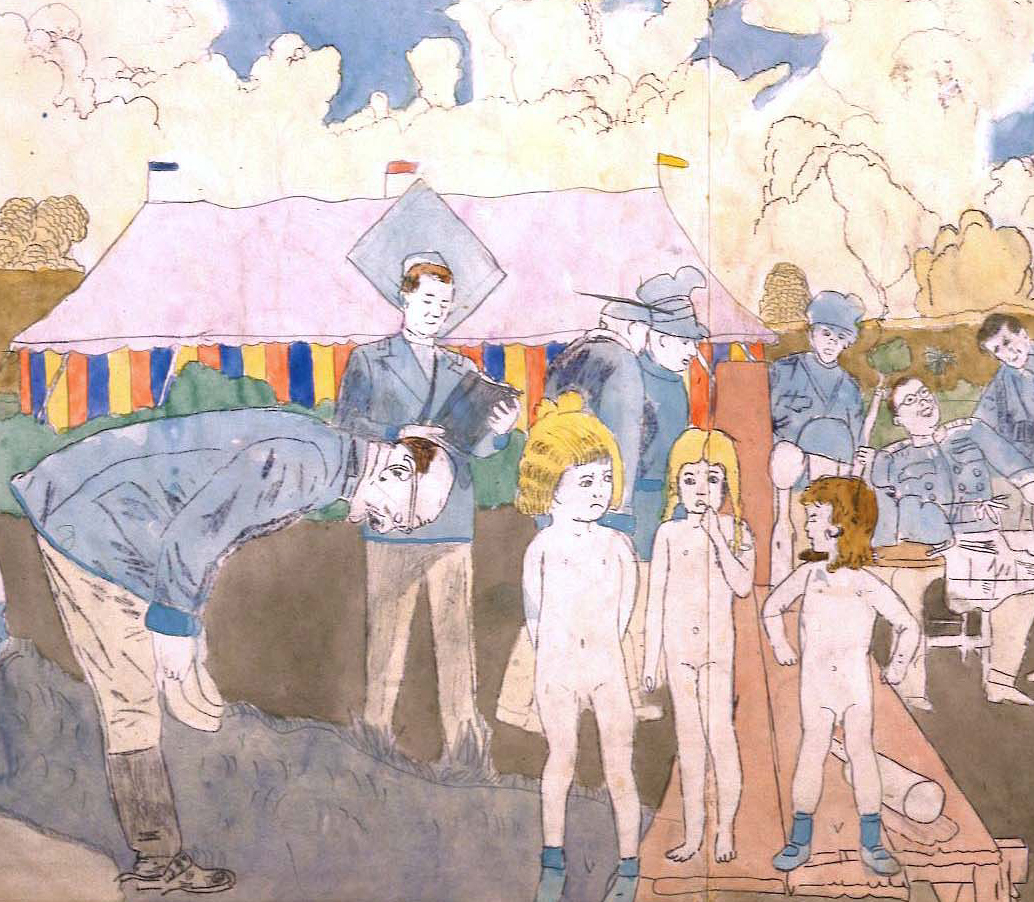
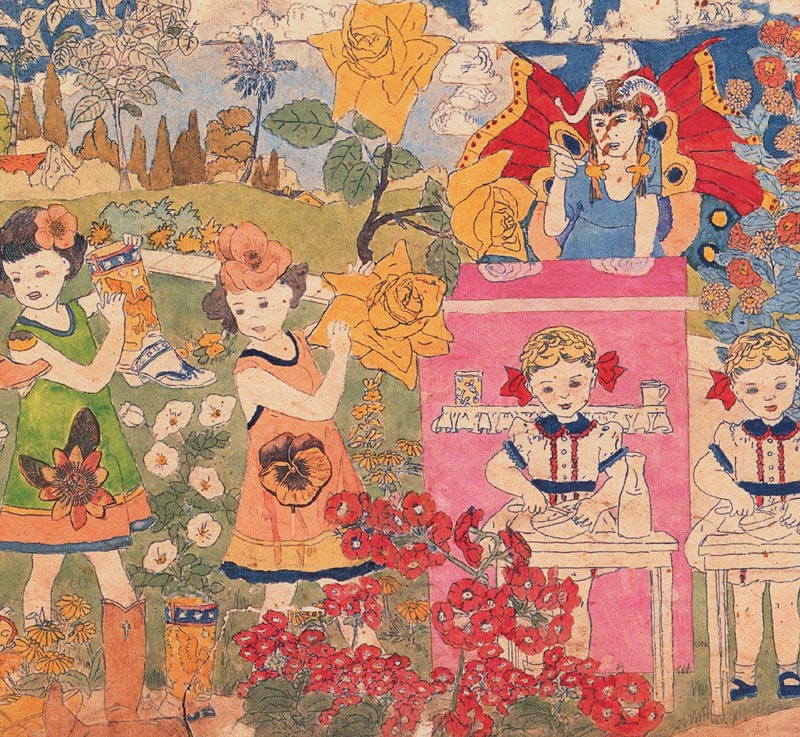
Henry Darger "Realms of the Unreal"


Henry Darger's unmistakable style unearths the realms of the unconscious, imaginary worlds that existed in his unique mind. The Vivian Girls are at war with the adults that enslave them. Henry sought to find the perfect image of innocence in the unmatched beauty of the Vivian Girls. There is a really enjoyable documentary on the Realms, I recommend.

Who/]

My photo
a blog about fancies, anonymous, and outsider art or art influenced by the outsider.
Powered by Blogger.